
Pages

▼
Drop Down MenusCSS Drop Down MenuPure CSS Dropdown Menu

Review: SealLine Baja Deck bag for expedition sea kayaking

A deck bag is crucial for long days on the water. It provides quick and easy access to things like phones, sunscreen, hats, snacks and Gatorade pouches.
I've used a few different deck bags over the years so my requirements evolved to be very specific.

What to look for in a good deck bag for sea kayaking:
  • Made from durable waterproof material
  • Rigid structure to make it easy for me to dig around in it single handed
  • Fast and easy to open- I don't want a deck bag with a roll top closure that takes forever to open and close
  • Fast to take on and off my boat
  • Low profile to reduce wind resistance
  • Small enough to safely put in my lap under my spray-skirt in high winds without hindering my ability to wet exit
  • Splash proof
  • Dlastic d-rings to attach a strap so I can easily carry the bag on my shoulder. When I get to Ocracoke I use my deck bag like a purse- which gets me lots of strange looks.


So far my all-time favorite deck bag is the Baja Deck Bag from SealLine.


What I Love 
Size & Storage
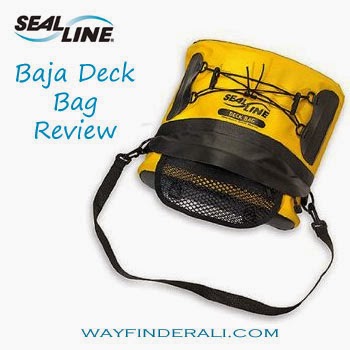
  • Perfect Size- It is big enough to hold what I need it to, but not so big that wind resistance is a problem. It is small enough to keep in my lap under my spray skirt in extremely high winds. It has a stiff plastic insert that keeps the upper side of the bag in a curve shape which keeps the bag from collapsing and makes it easy to find your stuff. 
  • Zippered Access- There is a zipper to get into the main part of the bag- which in the above photo is covered by a rubber flap to make the zipper more water resistant. There is an outer mesh pouch that I use to keep my chapstick and other random bits in. 

Attachment Points
  • Straps to Rigging- The bag itself attaches to the deck rigging with two tough strips of rubber lined with velcro with two plastic buckles at the end. Un-clip the buckles, pull apart the velcro, and slide the straps under your deck rigging then clip to secure. I find it easy and quick to put on and take off this deck bag. I have used other bags that attach in different ways and this method is my favorite. 
  • Bungee- I use the bungee on top to hold my map and hat sometimes. The clips on the bungee are made to be a fast and easy paddle holder. I've only used them to hold my paddle a couple of times- it worked but I didn't feel like it was that secure. 
  • Carry Strap- The removable strap is the perfect length to throw over my shoulder- making it easy to carry my bag to my tent or around Ocracoke as a handbag.

So far so good. It seems like the perfect bag- and it is. Except for one major flaw. 

     The zipper sliders are metal. Why is that a problem? This is a bag for sea kayaking- in the ocean. When exposed to salt water they corrode. And no longer open or close. So you either end up with a bag that is stuck open or a bag that's stuck closed. Neither is good. 
      These are also our deck bags of choice for our sea kayaking guides at Pamlico Sea Base. We have four of them that our guides use all summer. In order to keep them working, the zippers have to be sprayed with silicone lubricant at the end of every trip. This is obviously annoying. 
      After sitting idle from August to May during our off season, they are stored in a closet in our boat shed. The boat shed is three sided, so although the deck bags don't get rained on, they aren't protected from the humidity in the air. After 9 months sitting idle, none of the zippers work. They are stuck closed. 
So until they fix this massive error, I can't say that the Baja Deck Bag is the perfect deck bag, but it's the best I've used so far. 

Dibba Fish Market

The fish market- on a not-so-busy day
Wander into the mina (port or harbor) in Dibba any afternoon except Friday and your nose will find the fish market for you. The buzz of activity is hidden from the road by big refrigerated trucks waiting to be filled with fish. Weaving through and often squeezing between the trucks you'll come upon an open area with orange tarps laid out to protect freshly caught fish from pavement. There is never enough tarp space, so many fisherman display their catch on their boats.  There are no size limits, catch limits or restricted species here- so you'll see a huge variety of marine life at the fish market. Large sharks are pretty common- along with parrot fish, cuttlefish, squid, black tuna, grouper, red snapper, swordfish and a bunch of others that I don't recognize.

An enormous hammerhead shark. We guessed it was 14 feet long.
The shark next to it was a decent size shark at around 8 feet
It's easy to be intimidated here, especially for Westerners. Everyone is shouting in Arabic, people are walking quickly from seller to seller, fish are being packed into baskets layered with ice and heaved into trucks. There is constant movement and constant noise. Browsing the catch on the tarp means gingerly stepping between carcasses on slippery, blood and water covered tarps. Push your way through crowds to get a look at the catch on the boats. If you can't identify fish species, and more importantly don't know which ones are tasty, don't go without someone who does. The locals don't know the western fish names. It is typically warm and sunny at the fish market- the smell of sweat mingles in the air with the fish smell- and there's fish grime and guts all over the ground. Stray cats hang around trying to steal small fish when no one is looking.  Don't wear nice shoes and expect to leave feeling grimy.

Kent and the snapper
The first time we went, I was determined to buy a fish- we were planning a cookout that night. I found a nice big red snapper I wanted. I just stood there pointing downward and asking every man that passed "how much." Eventually my stubbornness paid off because someone who spoke a little English appeared to bargain with me. He was asking 250 dirhams- around $75- way, way out of our budget. Haggling is customary and expected here. A decent price is usually half of the amount they start at. I wanted to pay 140 dirhams- around $38 for the fish, but I couldn't get him below 180.  My companions and I gave up and walked away. We were checking out some black tuna on one of the boats when someone tapped Kent on the shoulder.
     "It's okay 140," the man says, wobbling his head to the side and waving his hand with a single flick of his wrist.  We headed back over to the snapper.
  After collecting our fish we head to this building where we can pay $3 to have our fish cleaned. The building feels vastly empty, clean and quiet compared to the fish market.

The guys who clean the fish don't speak English, so I motion as if I am holding a knife and cutting a fillet off the fish and the guy gets the idea.


A smaller snapper -photo credit Jessa Hobson
He scrapes the scales off with a short board with nails sticking out of it before pulling the guts out. Tony and Kent left me to supervise the cleaning process while they went back to buy a tuna. The fish cleaner slid his knife into the fish flesh by the gills to slice the fillet off. The fillet was nearly three inches thick and at least a foot long. I tried desperately to call Tony to tell him not to buy a tuna. Oman mobile cell phone signal isn't the most reliable. Not knowing if he could hear me or not, I tried to tell them that the snapper fillets were huge and not to buy a tuna. Much to my amazement Tony and Kent returned without a tuna. Apparently the only word Tony could make out was "huge" so they assumed I was trying to tell them that the fillets were enough to feed everyone.
This first successful trip to the fish market let to many more. We learned to walk away from a fish we really wanted only to be tapped on the shoulder as we stood browsing by the competitor's boat. We also learned just how much we could get away with paying for these fish. I got the snapper pictured below for 50 dirhams - just over $10. We originally agreed on 40 dirhams but when I pulled out a 50 and expecting to get change, the price jumped to 50 dirhams. Next time we'll bring exact change.

Curtis and Kent's Perfectly Easy Red Snapper
Ingredients:
-red snapper fillets with skin still on (the skin adds flavor and is good for you)
-sliced lemon
-garlic
-butter
-salt
-pepper
-basil
-aluminum foil

Directions
Place fish fillets on flat pieces of foil, skin down. Chop fresh garlic cloves into relatively small chunks and place around fish. Sprinkle salt, pepper and basil onto the flesh of the fish. Place several chunks of butter on top of the flesh. Then lemon slices on top. Fold, roll and pinch the foil to make airtight pouches. 
Place pouches on grill with medium-high heat until fish flakes easily with a fork. Serve with tasty alcoholic  beverage.

Dad's gonna be jealous....

It looks like my Dad is going to have to fly half way around the world to get his fix of Krispy Kreme.
That's right. Krispy Kreme, the doughnut company (founded in my dad's home town might I add) has stopped making the Kruller. Stopped making the Kruller, except in Dubai apparently.

I took a photo to prove it.


Mike came to visit us in Dibba last night. We were at the beach when he arrived at our house. We got a call from one of our housemates.

Kent: "Mike brought us presents, they're on the kitchen table."
Curtis: "What, booze?"
Kent: "Better. Krispy Kreme."

So Dad, I couldn't exactly bring it home for you. It would definitely get stale and possibly moldy during the 8 days until I leave, and then the 10 days in France. So I did the next best thing. I ate it and took photos!


Sharjah Souqs

On a day off in February, we decided to see the souqs of Sharjah. In UAE and Oman, souqs are shops that sell traditional and modern items. The souqs are often organized by type- textiles, produce, spices, etc. Haggling is expected and respectful. Only fools (and tourists) pay full price.

During our drive, we saw a man riding a camel across a busy highway. I’m sure drivers around us were annoyed as we slowed to take photos.


Sharjah is an extremely confusing city to get around. The signs tell you what neighborhood a street heads toward instead of what major highway or direction they go- this is really frustrating for anyone who doesn’t have the layout of Sharjah neighborhoods memorized. Luckily we had a Time Out Dubai book with a basic map of Sharjah- enough to get us to the right neighborhood. We arrived at mid-day- not the best time for shopping because many shops are closed- but a great time to find free parking. We parked in a free spot right next to the Central Souq where Jessa was excited to take her shoes off in real grass.

The Central Souq


The central souq is two large, two story buildings, connected by hallways that pass over a road. The second floor is full of more traditional wares- jewelry, silver, old cultural relics, pashmina shawls, and carpets. Most of the shops on the bottom floor sell modern clothes, shoes, and jewelry. The more traditional souqs are captivating- each in their own way.
Some shops are a feast for the eyes- with glowing glass lamps in hundreds of colors.
This souq is packed to the brim with housewares, illuminated by the lamps and lanterns within. We all love to daydream about owning one of the big chandeliers.

Souqs with ancient artifacts transport you to other places and times - times of adventure and intrigue- when the far reaches of the world were still mysterious and the wonders of the world not yet understood. Some of the items here are thousands of years old- or so the shop keeper claims. In this case are coins from 195 BC, ancient Egyptian gold jewelry and Arabian knives. I held a pair of gold and jade earrings supposedly from Ancient Egypt. I wonder if looters stole them from a tomb furnished for the inhabitant’s afterlife.

A display case filled with old knives, coins and jewelry.


Old belt buckles


A beautiful revolver covered in Arabic script. I think this would have been my gun if I was a pirate.


And one of these my sword...


Afghani jewelry on display


One souq we really enjoyed was one full of more modern exotic items. The wares here were just as exotic and traditional, but not ancient and therefore less expensive. Tony found Tibetan prayer bowls he liked. I found brass spyglasses, ship’s helms, heirloom brass compasses and this throttle for a steam boat- just like the throttle on first ferries that ran to Ocracoke from the mainland. It would be awesome to have a throttle like this one at Pamlico Sea Base, or even one of the ships' helms so I asked for prices.


The shop keeper was asking 25,000 dirhams - around $6,800, for the throttle. The helms (ship’s wheel) were going for 600 to 900 dirhams. I could probably talk him down to 400 ($108) or so, but getting it home would be a challenge.
Coffee pots, a diving suit helmet, statues from the far East and traditional hookahs.


Enchanted by the relics within, we left the central souq scheming buy things when we returned.
Hungry, we wandered the streets until we found a Lebanese restaurant where you eat in the traditional way- seated on a carpet floor sharing a communal meal. We bought a variety of dishes and shared.


We hit the streets again to find Old Sharjah- where remnants of the old city remain. The buildings here are low and made from the resources available to those early inhabitants. We walked the narrow passageways and wondered at the construction of the buildings.
Tony and me walking down a lane


Jessa


Old and New Sharjah


A beautiful doorway


The buildings were constructed by stacking chunks of coral like bricks


There are souqs in Old Sharjah- but unfortunately they are only open in the mornings so we missed out on this trip. We looked into the windows of the souqs to see a trove of awesomely cool stuff -like carved ibex horns, giant platters carved with Arabic script, leopard skins and traditional furniture- so we’re planning to go back sometime to check them out.
Our last stop was the animal souq. We parked nearby and followed our noses to the shops. The smell of livestock and hay is detectable from several blocks away and is very conspicuous in the middle of a big developed city.


The sellers were excited to see westerners in their market and were eager to let Jessa and me hold baby goats and lambs.


One local guy bought a sheep. We were shocked and amused when he pulled his car up and the sheep was loaded into the trunk.


Deer were for sale too, although I can’t imagine what purpose they serve.


We strolled by the stalls selling cattle and horses, and then noticed a small goat was out of it’s pen. Jessa and I were inside the stall with the loose goat, Tony and Stephen were outside the stalls walking in the dirt driving lane. We tried to get the attention of the shopkeepers to alert them to the goat. They were preoccupied, and we quickly learned why. As we tried to get their attention, two men came bolting out of the neighboring stall, running full speed and looking over their shoulders. A bull had gotten loose, and he was angry. He chased the men, swinging his horns to and fro at them. One man made a futile attempt to stop it by stepping on the lead rope that dragged behind it. Tony jumped behind a tall metal gate and Stephen behind a car. I watched the bull exit the neighboring stall. I was in the neighboring stall, surrounded by walls and filled with pens of sheep. With nowhere to go, I hoped the bull wouldn’t turn and stood still to not attract attention. My efforts were not rewarded, he turned and ran into my stall. I knew he wouldn’t bother trying to knock a fence down, so I jumped in with the sheep and stood still. What I didn’t know was that Jessa was also in the same stall with me, standing behind me. She didn’t notice his direction change until he was running right toward her. As Tony and Stephen looked on, she frantically looked around for somewhere to go. Seeing me standing with the sheep, she leapt like a deer over the fence and quickly turned back toward the bull, shielding herself with her arms, holding the fence and nearly knocking me over in the process. The bull stayed his course and ran right to the back of the stall down a narrow lane. Unable to turn and unwilling to walk backward, he was stuck. The shopkeepers, Tony and Stephen came out from behind their hiding places and stood at the sheep pen. The Pakistani and Bengali keepers were bent over with laughter. Once they had contained themselves, Tony asked them how much for the two American sheep which set them off laughing again. Jessa and I climbed out of the sheep pen and we headed to the indoor animal souq where all the pets are sold.

We were hit by a wall of stench as we stepped inside. Each vendor has a variety of pets- you’ll often find cats, dogs, fish, parrots, rabbits and mice all in one shop. A few years ago you could find really exotic pets like tigers and leopards here but laws have changed in the past few years and you’ll rarely find such animals in plain sight. The shop keepers here are very willing to put birds on your shoulders and puppies in your arms. Tony and Jessa made friends with a parrot.


Falcons are one of the best selling birds here because of the long standing hunting tradition. Many Emirati men own falcons and train them to hunt. Unlike in the States, here you don’t need to be a licensed falconer to own one.


Now that we knew had the Sharjah souqs figured out, we vowed to bring the rest of the gang to check them out one day.

Aqabat Village Trek

A few weeks ago, I tagged along with Jessa and Ram on the Aqabat village trek. Aqabat village is an extremely remote village high in the Hajar mountains of the Musandam peninsula of Oman. Just getting to the trail head requires a 45 minute 4x4 ride through the steep rocky gorge of Wadi Khabb A’ Shamsi to the top of the wadi where the drainage begins. Then trek for an hour and a half through the mountains to reach the village.

I love this trek because of the diverse experiences it offers. Most of the trail is surrounded by breathtaking views of the high mountains. The ecosystem of the high mountains is very different from the lower elevations- there is more vegetation and because of the surrounding wilderness the wildlife is more abundant. My other favorite thing about this trek is the cultural aspect - seeing an old village still inhabited- the combination of the old ways and new technologies used in tandem. Relics of the old ways still sitting as if they were used yesterday.

Aquaba - Lima Trek with Absolute Adventure

Of all the treks at Absolute Adventure, Aquaba-Lima is the most popular. After 2 half seasons here, I still hadn't gotten to do it. Finally my chance came last week.
The weather was gorgeous and the sea was nice and calm for our 45 minute speed boat ride to Aquaba. We left from the Mina in Dibba and sped along the coast where the mountains dive into the sea. This part of the Arabian peninsula is called the Musandam Peninsula and is known for its dramatic fjords.

If you would like to go on this trek, you can sign up on Absolute Adventure's webiste here.