Pages

▼
Drop Down MenusCSS Drop Down MenuPure CSS Dropdown Menu

Werner Kalliste Review: A Sleek and Sexy Badass Blade


The Kalliste by Werner Paddles is an elite performance, sleek and sexy carbon fiber paddle for low angle paddlers. This beauty will set you back about $400. Is it worth the money? Keep reading to find out why it's totally worth it.

Specs:
  • Shaft: carbon fiber available straight or bent
  • Blades: carbon fiber with foam core
  • Ferrule style: 180 degree feathering adjustment right and left
  • Weight: 23.25oz to 26 oz depending on length and shaft size/type


Features:
  • Foam core blades: buoyant carbon fiber blades make each stroke smoother and lifting the blade out of the water at the end of the stroke effortless
  • Dihedral power face: the three dimensional face of the blade eliminates the 'flutter' of the blade through the water which is present in paddles with smooth power faces. This makes your strokes more efficient and reduces wrist and arm strain. 
  • Smooth back face: a smooth back face makes for a smooth entry into and out of the water, unlike a fiberglass paddle which has a spine on the back face of the blade.
  • Smart view adjustable ferrule: gives the look and feel of a single piece shaft with a tremendous range of feathering which allows you to adjust the feather to both your paddling style and wind. There is nothing to get caught on your clothes or gear, and you can alter the feathering quickly and easily on the water. I love the way it looks and feels like a single piece paddle.

Review: SealLine Baja Deck bag for expedition sea kayaking

A deck bag is crucial for long days on the water. It provides quick and easy access to things like phones, sunscreen, hats, snacks and Gatorade pouches.
I've used a few different deck bags over the years so my requirements evolved to be very specific.

What to look for in a good deck bag for sea kayaking:

  • Made from durable waterproof material
  • Rigid structure to make it easy for me to dig around in it single handed
  • Fast and easy to open- I don't want a deck bag with a roll top closure that takes forever to open and close
  • Fast to take on and off my boat
  • Low profile to reduce wind resistance
  • Small enough to safely put in my lap under my spray-skirt in high winds without hindering my ability to wet exit
  • Splash proof
  • Dlastic d-rings to attach a strap so I can easily carry the bag on my shoulder. When I get to Ocracoke I use my deck bag like a purse- which gets me lots of strange looks.


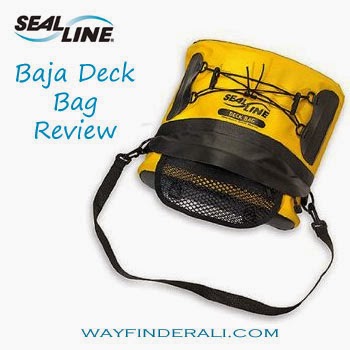
So far my all-time favorite deck bag is the Baja Deck Bag from SealLine.


What I Love 
Size & Storage
  • Perfect Size- It is big enough to hold what I need it to, but not so big that wind resistance is a problem. It is small enough to keep in my lap under my spray skirt in extremely high winds. It has a stiff plastic insert that keeps the upper side of the bag in a curve shape which keeps the bag from collapsing and makes it easy to find your stuff. 
  • Zippered Access- There is a zipper to get into the main part of the bag- which in the above photo is covered by a rubber flap to make the zipper more water resistant. There is an outer mesh pouch that I use to keep my chapstick and other random bits in. 

Attachment Points
  • Straps to Rigging- The bag itself attaches to the deck rigging with two tough strips of rubber lined with velcro with two plastic buckles at the end. Un-clip the buckles, pull apart the velcro, and slide the straps under your deck rigging then clip to secure. I find it easy and quick to put on and take off this deck bag. I have used other bags that attach in different ways and this method is my favorite. 
  • Bungee- I use the bungee on top to hold my map and hat sometimes. The clips on the bungee are made to be a fast and easy paddle holder. I've only used them to hold my paddle a couple of times- it worked but I didn't feel like it was that secure. 
  • Carry Strap- The removable strap is the perfect length to throw over my shoulder- making it easy to carry my bag to my tent or around Ocracoke as a handbag.

So far so good. It seems like the perfect bag- and it is. Except for one major flaw. 

     The zipper sliders are metal. Why is that a problem? This is a bag for sea kayaking- in the ocean. When exposed to salt water they corrode. And no longer open or close. So you either end up with a bag that is stuck open or a bag that's stuck closed. Neither is good. 
      These are also our deck bags of choice for our sea kayaking guides at Pamlico Sea Base. We have four of them that our guides use all summer. In order to keep them working, the zippers have to be sprayed with silicone lubricant at the end of every trip. This is obviously annoying. 
      After sitting idle from August to May during our off season, they are stored in a closet in our boat shed. The boat shed is three sided, so although the deck bags don't get rained on, they aren't protected from the humidity in the air. After 9 months sitting idle, none of the zippers work. They are stuck closed. 
So until they fix this massive error, I can't say that the Baja Deck Bag is the perfect deck bag, but it's the best I've used so far. 

Review: Stohlquist Kitty PFD


I got really lucky last week; I got a nearly brand new life jacket for free. Reggie (my boss) had a size small, women’s specific Stohlquist brand touring life jacket. I’m not sure if I would have chosen it for myself if I were ordering one, but I sure was glad to get it, and it fit! I’m used to wearing a Chica by Extrasport. So I tried them both on in my room to compare and decided to take a big risk: test the new jacket during a week in the field. Why was this risky? If I found out after an hour of paddling I hated the jacket, I had to paddle 20 or 30 more hours in it. This life jacket was superb throughout the trip and I continued to use it all summer. I never had any rubbing or chaffing problems. My perspective is from a guide, paddling 5+ hours a day in my life jacket. I am 5'2," 130lbs and wear a 34B. Here are some things I love about the jacket, and a few things I might change.

Great things:
*the foam in the chest of the vest is cut away to keep from squishing breasts
*the front pocket is nice. It’s easy to stick my hand into and dig around but wasn’t big and bulky. The pocket is completely flat, but ingeniously they put two pieces of neoprene at the edges to give the pocket enough stretch to dig around in.
*low profile and out of my way. My arms never rubbed against it when I paddled
*reflective piping for visibility in low light
*an accessible place to put my rescue knife
*mine is orange, which is very visible during the day from a long way away
*there are two buckle points that reinforce the zipper. You can buckle (quick release buckles) it closed before you zip it, which makes zipping it faster and easier.

Things I would change:
*It’s a pull-on style PFD which got pretty annoying because I wear a big hat when I paddle. When we stopped on an island I had to take my hat off to take my life jacket off. Of course, the Extrasport Chica I compared it to has a zip front. This makes for easy on/off except that as the Chica wears the zipper gets harder to zip up and there is only one buckle point at the bottom of the vest. So the pull on could be an advantage in some ways.
*this PFD would probably be problematic with a kayak that has a high seat back (instead of a back band) because the lower back of the PFD is rather thick
*the shoulder straps aren’t adjustable in length. If I had bigger breasts, the life jacket would probably ride up all the time or suffocate me.
*I would add another knife placement on the back of the jacket, up high, in case I wanted to carry two different knives or keep my knife on my back instead of in front of me
*the knife placement was sometimes annoying. I usually didn’t have problems, but a couple of times got things caught on my knife. I have a NRS Co-Pilot.

I really like this jacket and am really lucky to have gotten it for free. Many kayakers who spend long hours paddling may want more pockets or more adjustment. I really like this jacket, but if I were buying one, I might also consider the TowMotion or the Cruiser by Stohlquist.

Shopping for a kayak? Check out Ali's review of the Tsunami 160 by Wilderness Systems

Review: Wilderness Systems Tsunami 160 with rudder


I paddled this kayak on every trek I lead from 2009 to 2012. I racked up somewhere around 900+ miles in it, in all kinds of conditions. Here's what I liked, and what I hated.

A few things to note before you read- 
  • I paddled in the sound, where waves are more like chop and less like rolling swell. 
  • My review is from the perspective of a guide. As a guide, I look for things in a boat that many paddlers typically don't care about and may even look for opposite characteristics. 
  • I am 5'2" tall and weigh 130lbs.


The specs:
  • 16 feet long
  • 23.5" wide
  • 58lbs
  • 325lb carrying capacity
  • rudder, no skeg
  • 3 hatches and 3 foam bulkheads


What I Like
  • Storage Space - I packed all my gear, personal food and all the extra bits a guide has to have in this boat, and I had room for more. Unlike boats with skegs, you can put your stuff in larger dry bags instead of having to pack everything in tiny dry bags. I could pack and unpack my boat quickly and easily.

  • Comfort -
    Width: The width of this boat was a little wide for me, but it is made for a medium size paddler, not a little person like me. Adding hip pads gave me a snug enough fit to Eskimo roll, and the extra width allowed me to sit cross-legged when my legs cramped. The boat is narrow enough that I usually didn't hit my hands on the sides as I paddled.
    Deck Height: The height of the deck at the cockpit could have been lower but it rarely got in the way. Its height suited my low angle paddling style and was high enough out of the water even fully loaded.
    Cockpit Length: At the end of the season, I discovered I could take my feet off the pegs, scoot down in my boat and lay completely flat inside the cockpit! Add two paddle floats and I can have a nap!Seat:

  • Durability - This boat may be heavy for some, but I can still carry it by myself. A roto-molded plastic boat is durable and worth the extra weight. I loved not having to worry about bumping other boats, oyster shoals, or rocks. A composite boat would not have survived the constant abuse of weekly expeditions. Unless you burn a hole in it, the boat itself will last a long time, as long as you store it out of the sun. This boat is extremely sensitive to UV and the plastic is weakened dramatically by heat and sunlight. The rudder kit that was included rarely gave me problems and when it did I could easily fix it with my repair kit. 

  • Stability - Very high initial stability. Feels very stable  to beginner and intermediate paddlers.

  • Tracking -  This boat tracks extremely well in calm water. Tracking is not very good in wind or chop. You need a rudder to go straight in wind from any direction. 

  • Hatches -  I loved having a day hatch. The larger opening in the rear hatch enabled me to cram in all my bulky stuff. The opening in the front hatch is much smaller but still large enough that I never had any issues getting anything to fit through it.


What I Don't Like


  • Comfort- While this wasn't an issue for me, taller or larger men and women don't fit in this boat at all. If you are tall (over 5'9") or big boned this boat won't fit you.

  • Durability- Don't sit on the deck of this boat when it's on land and don't let anyone sit on the deck of your boat while you are sitting in it (in the water) unless absolutely necessary. Doing either of these things causes the bulkheads to leak. This is easily fixed with some marine sealant, but I've discovered wet things in my hatches that I would have rather stayed dry. I have gotten pretty annoyed having to reseal the bulkheads frequently, even when I take really good care of the boat. Other than this, my hatches stayed extremely dry. The plastic loses a TON of its rigidity when it sits in sunlight for prolonged periods of time.If you guy this boat, protect it with 303 and store it out of the sun. Also, the rudder has a tendency to work its bolts loose and spin, up and out of the water. This is easily fixed if you know how to do it and you have an Allen wrench handy. This happened so frequently (to participant boats with these rudders) that I got the hang of fixing them on the water.

  • Stability- This boat has little secondary stability. It doesn't edge very cleanly. Maybe because of my small size I had a hard time getting it up on its edge. Overall I didn't feel vulnerable unless I was in 3 foot following chop or broadside chop above 3 feet. This instability would be magnified for someone who doesn't pack the boat properly for conditions.

  • Tracking- This boat doesn't track well in chaotic seas or wind. It weathercocks pretty severely because there is a little too much rocker in the stern. It is somewhat solved by deploying the rudder. It's even harder to turn (even on its edge) in chaotic seas. I struggled frequently to keep my bow pointed where I wanted it to in such situations, even with the rudder. Sitting next to a fellow guide in chop (she was paddling a Wilderness System Cape Horn 15, with no skeg or rudder!) and her boat slid through the chop as mine bounced around in it. Both our boats were fully loaded and we weigh about the same. This has everything to do with hull design.

Overall, I wouldn't buy this boat. I enjoyed paddling it and it generally has everything I need in a guiding boat but I think I could buy a boat that handles better made from better plastic for around the same price. This boat is great for those just entering the multi-day sea kayaking world who want a boat that's easy to paddle and pack and will survive collisions with rocks and oyster beds. Those who enjoy or plan to paddle during not so nice weather should stay away. Well seasoned guides may want a more athletic, performance oriented boat. If I had to buy a Wilderness Systems sea kayak, I would buy a Tempest. It's only a couple hundred dollars more and much better suited to expedition sea kayaking. That being said, there are several other plastic sea kayaks of the same length, similar storage capacity, and similar price point, that shine in all areas a wider range of conditions; like the Scorpio by P&H, for example.

Shopping for a PFD? Check out my review of the Kitty PFD by Stohlquist