Pages

▼
Drop Down MenusCSS Drop Down MenuPure CSS Dropdown Menu

Dibba Fish Market

The fish market- on a not-so-busy day
Wander into the mina (port or harbor) in Dibba any afternoon except Friday and your nose will find the fish market for you. The buzz of activity is hidden from the road by big refrigerated trucks waiting to be filled with fish. Weaving through and often squeezing between the trucks you'll come upon an open area with orange tarps laid out to protect freshly caught fish from pavement. There is never enough tarp space, so many fisherman display their catch on their boats.  There are no size limits, catch limits or restricted species here- so you'll see a huge variety of marine life at the fish market. Large sharks are pretty common- along with parrot fish, cuttlefish, squid, black tuna, grouper, red snapper, swordfish and a bunch of others that I don't recognize.

An enormous hammerhead shark. We guessed it was 14 feet long.
The shark next to it was a decent size shark at around 8 feet
It's easy to be intimidated here, especially for Westerners. Everyone is shouting in Arabic, people are walking quickly from seller to seller, fish are being packed into baskets layered with ice and heaved into trucks. There is constant movement and constant noise. Browsing the catch on the tarp means gingerly stepping between carcasses on slippery, blood and water covered tarps. Push your way through crowds to get a look at the catch on the boats. If you can't identify fish species, and more importantly don't know which ones are tasty, don't go without someone who does. The locals don't know the western fish names. It is typically warm and sunny at the fish market- the smell of sweat mingles in the air with the fish smell- and there's fish grime and guts all over the ground. Stray cats hang around trying to steal small fish when no one is looking.  Don't wear nice shoes and expect to leave feeling grimy.

Kent and the snapper
The first time we went, I was determined to buy a fish- we were planning a cookout that night. I found a nice big red snapper I wanted. I just stood there pointing downward and asking every man that passed "how much." Eventually my stubbornness paid off because someone who spoke a little English appeared to bargain with me. He was asking 250 dirhams- around $75- way, way out of our budget. Haggling is customary and expected here. A decent price is usually half of the amount they start at. I wanted to pay 140 dirhams- around $38 for the fish, but I couldn't get him below 180.  My companions and I gave up and walked away. We were checking out some black tuna on one of the boats when someone tapped Kent on the shoulder.
     "It's okay 140," the man says, wobbling his head to the side and waving his hand with a single flick of his wrist.  We headed back over to the snapper.
  After collecting our fish we head to this building where we can pay $3 to have our fish cleaned. The building feels vastly empty, clean and quiet compared to the fish market.

The guys who clean the fish don't speak English, so I motion as if I am holding a knife and cutting a fillet off the fish and the guy gets the idea.


A smaller snapper -photo credit Jessa Hobson
He scrapes the scales off with a short board with nails sticking out of it before pulling the guts out. Tony and Kent left me to supervise the cleaning process while they went back to buy a tuna. The fish cleaner slid his knife into the fish flesh by the gills to slice the fillet off. The fillet was nearly three inches thick and at least a foot long. I tried desperately to call Tony to tell him not to buy a tuna. Oman mobile cell phone signal isn't the most reliable. Not knowing if he could hear me or not, I tried to tell them that the snapper fillets were huge and not to buy a tuna. Much to my amazement Tony and Kent returned without a tuna. Apparently the only word Tony could make out was "huge" so they assumed I was trying to tell them that the fillets were enough to feed everyone.
This first successful trip to the fish market let to many more. We learned to walk away from a fish we really wanted only to be tapped on the shoulder as we stood browsing by the competitor's boat. We also learned just how much we could get away with paying for these fish. I got the snapper pictured below for 50 dirhams - just over $10. We originally agreed on 40 dirhams but when I pulled out a 50 and expecting to get change, the price jumped to 50 dirhams. Next time we'll bring exact change.

Curtis and Kent's Perfectly Easy Red Snapper
Ingredients:
-red snapper fillets with skin still on (the skin adds flavor and is good for you)
-sliced lemon
-garlic
-butter
-salt
-pepper
-basil
-aluminum foil

Directions
Place fish fillets on flat pieces of foil, skin down. Chop fresh garlic cloves into relatively small chunks and place around fish. Sprinkle salt, pepper and basil onto the flesh of the fish. Place several chunks of butter on top of the flesh. Then lemon slices on top. Fold, roll and pinch the foil to make airtight pouches. 
Place pouches on grill with medium-high heat until fish flakes easily with a fork. Serve with tasty alcoholic  beverage.

Notes on Dubai

Only in Dubai will you hear your American friend yell to his German buddy "Yella Habibi!" Arabic for "Let's go, my love"

Nearly half of the buildings here are in various stages of construction, with cranes and scaffolding everywhere. The skyline is littered with cranes. We play the crane game as we walk through the city- who can spot the most. Do the cranes on super yachts in the marina count? Just construction cranes? I can easily count twenty in view as I walk two blocks.

Dubai lacks a grounded sense of culture. Its like a giant international airport in an Arab country. There are clues to tell you where you are, but everyone and everything is from all over the place. Your taxi driver speaks four, maybe five languages. You can buy groceries with three different currencies.

There is this one section of the main drag, along Sheikh Zayed Road, where the skyline is really weird and ominous. In Manhattan, the skyscrapers form this mass of skyline, surrounding each other to form a dense downtown. Dubai doesn't have that density. So many of the skyscrapers are pretty solitary. It looks really bizarre, a skyscraper surrounded by three and four story buildings. This one section of Sheikh Zayed Road is lined on each side by skyscrapers. But behind them are tiny single and two story buildings. When you drive down the road, its like driving through a gauntlet. I found a photo on the internet that shows how dramatic it is.


You find yourself using words and phrases in daily interaction that come from places you have never been, in addition to the place you currently are. I adopted the following words:
'posh' from the United Kingdom
'braai' from South Africa
'post' from Germany
and my most beloved phrase;
'yella habibi' Arabic.

Cultural Immersion

The second week of March was what we called “hell week.” We had four school in camp during that week, and most of them overlapped. Sunday, Fujeirah men’s college arrived. These were Emerati locals between 19 and 21. As they moved into their tents, I heard sporadic doumbek being played and hoped they would bring them out and play for us. If you’ve heard traditional belly-dance or Middle Eastern music, you’ve heard doumbek.
After the locals left for their first activity, a German international school of 14-year-old coeds arrived. It would have been very inappropriate for both schools to stay in camp together, so we sent the Germans to camp out on the beach, which they were thrilled to do.
Mike stayed with the German group and the rest of us had dinner with the Emeratis. After dinner, they brought out two doumbeks and formed a drum circle. Most of the guys knew every word to every song. Randomly, guys would jump up in the middle of the circle to dance. Sometimes they shimmied and writhed like belly-dancers and other times they would dance provocatively with they pelvises moving close to the ground, no need for interpretation. Everyone was enthusiastic and loud, clapping, singing, drumming and yelling. Their Egyptian teacher stopped them momentarily to explain to us what was going on. He said that often at weddings one of the families would hire a troop of dancers and drummers. Usually the dancers are men dressed as women. I think once in a while there may be a woman dancer, who would dress up to look androgynous so no one could tell. The troop was paid to come and the dancers were tipped with money as they danced. Apparently this line of work is pretty lucrative. This tradition is quite taboo but happens more frequently than is admitted to. After the explanation, the music continued. The guys were talented dancers, with phenomenal rhythm and body control. The largest, heaviest guy could shimmy like a professional belly dancer. There were five or six other guys who would randomly jump up to dance who were also quite talented.
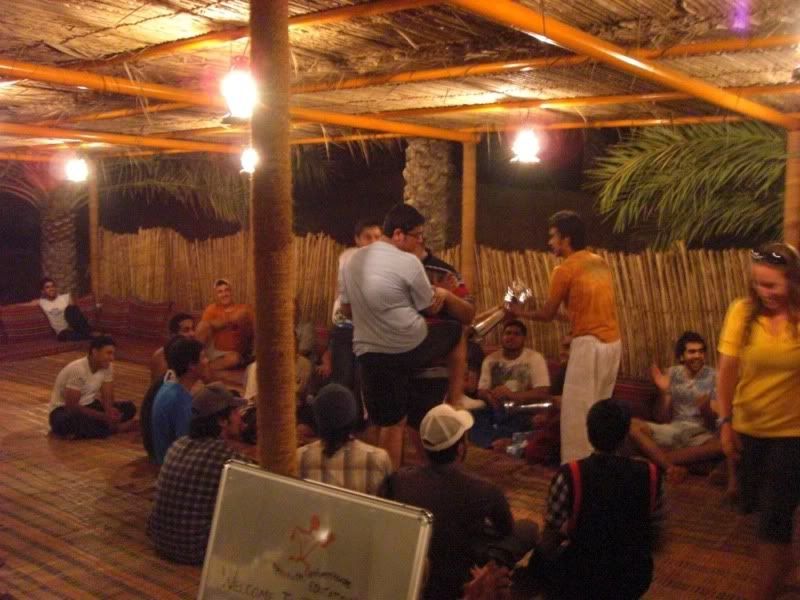
I was very impressed. We (the westerners) sat in the circle smiling and clapping along. They kept pulling our arms upward saying “miss miss, you dance!” We just shook our heads, not sure whether we would be inappropriate or not. Finally Micah stood up and jumped into the circle to dance. He lightheartedly booty danced in the center which made everyone erupt into laughter. Jesi didn’t want to dance, so she picked up a tabla and participated in the drumming. As the night grew later, those of us who weren’t spending the night at the plantation needed to leave. I was so hesitant to leave the music and the singing. For one last hoorah, Micah and I jumped into the center, dancing with our backs to each other. Micah booty danced and I belly danced. You could tell the locals were thrilled with our willingness to participate as the excitement and volume heightened.
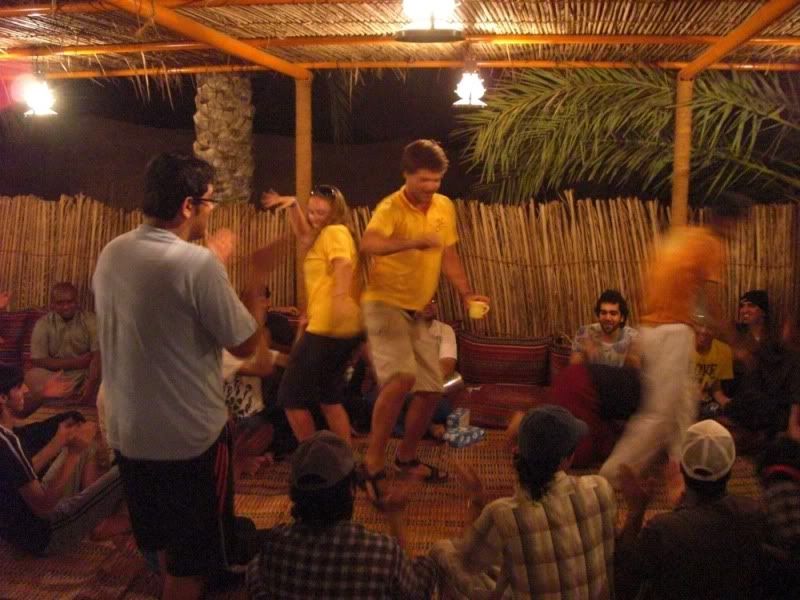
When we had danced our fill we jumped back out of the circle and soon the song ended. We were constantly thanked and congratulated as we gathered our things to leave. To Micah, they expressed gratitude for embracing their culture. I think he felt a sense of brotherhood. They all made me feel like a queen. The best moment was when the heavier Emerati guy who was the best dancer came over to me to tell me what he thought of my dancing. I wish they had stayed a second night.

Micah, Jesi and I drove into town to go to the internet café. We stopped to get gas and ran into Ahmed, the landlord of the plantation. He invited us to his home for Arabic coffee. He lives right next to the border in a fairly large traditional home with his wife and four children. We sat in a sitting room, complete with large plush couches and very elaborate curtains. Ahmed brought out first sweets, a tray of very nice creme caramel and bowls of jello. We ate all of it before the coffee. Arabic coffee is brought out in a traditional vessel that looks like a very tall and thin tea pot. The coffee is served much like tea is in Japan, in tiny little ceramic cups that you sip from. The coffee is much lighter and clearer than in the west, no where near as dark, and is made with lots of cardamom. When you are invited to someone's home for coffee, it is rude to only have one cup, and selfish or indulgent to have three. So we each had two cups. We chatted with Ahmed about everything from the politics of Oman and the UAE to the meaning of various Arabic words we had heard frequently. Jesi and I scrambled to write them down when we got to the car. We've got hello, thank you, left, right, you're welcome, my love/life, lets go, go, enough, no thank you, various articles of clothing and mountain climbing well enough to use frequently. We use as much as we can as often as we can, but so many people here speak such good English we haven't really been forced to learn much.
